 Freezedry Harvest
Instant meals
Vegetables that come back in the cup,
in minutes, in hot water.
Freeze-dried vegetables and herbs suit instant soups, ramen, miso and cup meals because the pieces are porous: hot water gets in fast and they come back close to their original shape. We supply organic spring onion and chive rings, diced onion, garlic and ginger, sweet corn and tomato pieces and herb flakes, each with a spec sheet.
01 — Why it rehydrates
Ice leaves an open structure that water can fill again.
In freeze drying the water in each piece is frozen, then removed as vapor without ever melting. The ice holds the cells in place while it goes, so the dry piece keeps its shape and is full of fine open pores. When the consumer pours hot water into the cup, the water runs back into those pores and the ring or dice softens quickly.
Hot-air drying pulls liquid water out with heat. The piece shrinks and its surface hardens (case-hardening), so water enters slowly and the piece does not fully recover. In one study on carrots, water moved into freeze-dried pieces about a hundred times faster than into air-dried ones.
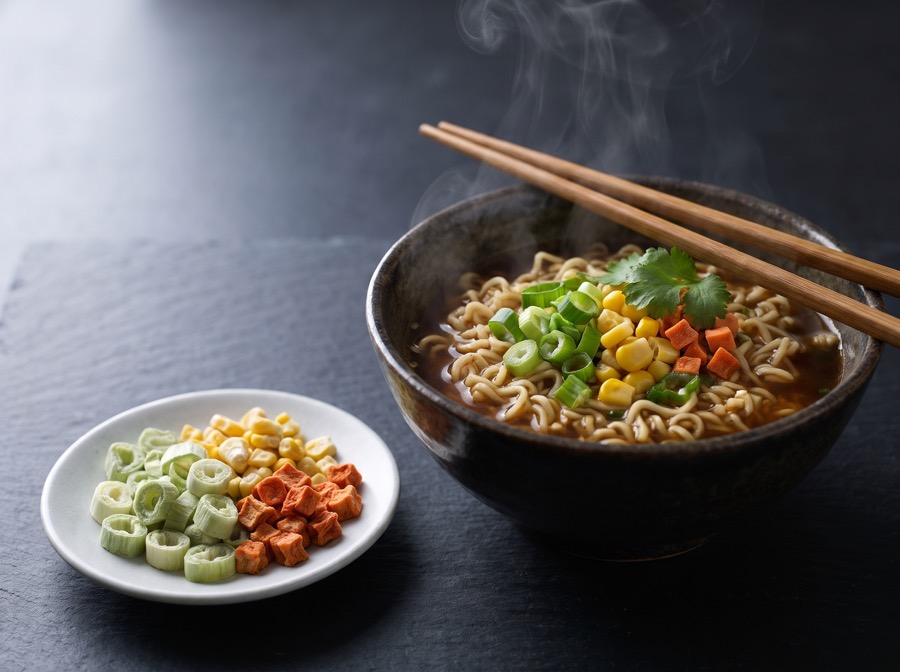
That matters most when the preparation time is short. A vegetable still chewy or curled when the cup is eaten is the first thing a consumer notices. The illustration above shows the product type, not our product or a customer's.
02 — Cuts for the cup
Which cut goes where in an instant meal.
These cuts are in our range now. All are certified organic. Carrot can be grown for your program.
| Cut | Typical place in the product | What to check on your bench |
|---|---|---|
| Spring onion rings | Ramen and miso toppings | Ring size against the cup; color after soaking |
| Chive rings | Cream soups, potato and egg cups | Fine rings should disperse, not float as a mat |
| Red and green chili rings | Spicy ramen and tom yum-style cups | Heat per serving; ask for the spec range |
| Diced onion | Broth kits, cup soups, meal bases | Dice size against your printed soak time |
| Diced garlic and ginger | Ramen sachets, miso, Asian broths | Visible dice or a finer cut |
| Sweet corn and tomato pieces | Corn soups, minestrone-style cups | Larger pieces: test at your lowest water temperature |
| Herb flakes: cilantro, parsley, dill, basil | Pho-style cups, vegetable soups, couscous pots | Color and aroma after soaking |
Products are single ingredients. We make custom cuts and blends with you; powders only when you ask.
03 — Designing the sachet
Five decisions to make before you write the spec.
Dosing and sachet design depend on your cup, your water and your price point. These are the questions we work through at trial.
- 1
Fix the preparation conditions
Write down the water temperature and soaking time on your pack, and run every rehydration test at those conditions.
- 2
Dose by visible pieces, not only by weight
Freeze-dried vegetables are very light, so a small weight gives many pieces. Set the dose from what the consumer sees on top of the cup.
- 3
Choose the cut to match the soak
Thin rings and flakes come back fastest; dice and larger pieces need longer. A short soak calls for a ring or a small dice.
- 4
Decide loose or in a sachet
Loose pieces on the noodle block are on show when the lid comes off. A separate sachet protects fragile rings and flakes in transit.
- 5
Specify the pack and the barrier
Freeze-dried pieces take up moisture from the air, so use a sachet film with a good moisture barrier.
Free samples come with a spec sheet for each ingredient, so you can run these tests on your own line.
04 — Water activity in the cup
Match the vegetables to the dry block they sit with.
In a cup, the vegetables share a sealed space with a noodle block, a seasoning powder and sometimes a paste. Moisture moves from the component with the higher water activity to the lower one until they balance, which can soften dry vegetables or cake a powder.
Freeze-dried vegetable and fruit powders are reported in the literature at 1.5–4% moisture and a water activity of about 0.20–0.35, typical published values rather than measurements of ours. The moisture target for each of our ingredients is on its spec sheet and agreed with you at trial. Keep any paste in its own pack.
Freeze drying is not a kill step, and the low water activity stops microbes from growing without killing them. Lots are micro-tested in our own lab. More on soaking times and ratios is in our rehydration guide.
05 — Questions
Questions buyers ask about freeze-dried vegetables for instant meals.
How long do freeze-dried vegetables take to rehydrate in an instant soup?
Freeze-dried rings, flakes and small dice take up hot water within minutes because the pieces are porous. The exact time depends on the cut, the piece size and the water temperature, so test samples at the conditions printed on your pack.
Why do freeze-dried vegetables rehydrate better than air-dried ones?
Freeze drying removes ice as vapor and leaves an open, porous piece that water can refill. Hot-air drying shrinks the piece and hardens its surface, so water enters slowly and the piece does not fully recover its shape.
Which freeze-dried cuts work in ramen and miso soup?
Spring onion and chive rings, diced garlic, ginger and onion, chili rings, sweet corn pieces and cilantro flakes are the usual choices. All of them are in the FD Harvest range and certified organic.
Can freeze-dried vegetables be packed loose with the noodle block?
Yes, if the water activities of the vegetables and the block are close and the cup is well sealed. Fragile rings and flakes travel better in their own sachet.
Do you supply a mixed vegetable blend for cup meals?
Our products are single ingredients by default. Blends and custom cuts are developed with you, piloted small at the plant and then scaled, with no minimum order.
How are freeze-dried vegetables for instant meals packed and stored?
They are packed straight after drying in metalized pouches, because freeze-dried pieces take up moisture from the air. Sealed, they keep for 3 years; once opened, reseal the pouch and keep it dry.
Contact us to discuss your product requirements.
Tell us the cup, the soak time and the cuts you want to test. We send free samples with a spec sheet for each ingredient.
Contact usSources
- Marabi A., Saguy I.S., Effect of porosity on rehydration of dry food particulates, J. Sci. Food Agric. 84 (2004)
- Ratti C., Hot air and freeze-drying of high-value foods: a review, J. Food Eng. 49 (2001)
- Moisture and water activity of freeze-dried powders, Sci. J. Gdynia Maritime Univ.
- METER Group, Solving moisture issues in snack foods