 Freezedry Harvest
Inclusions
Inclusions that stay crisp
inside the product.
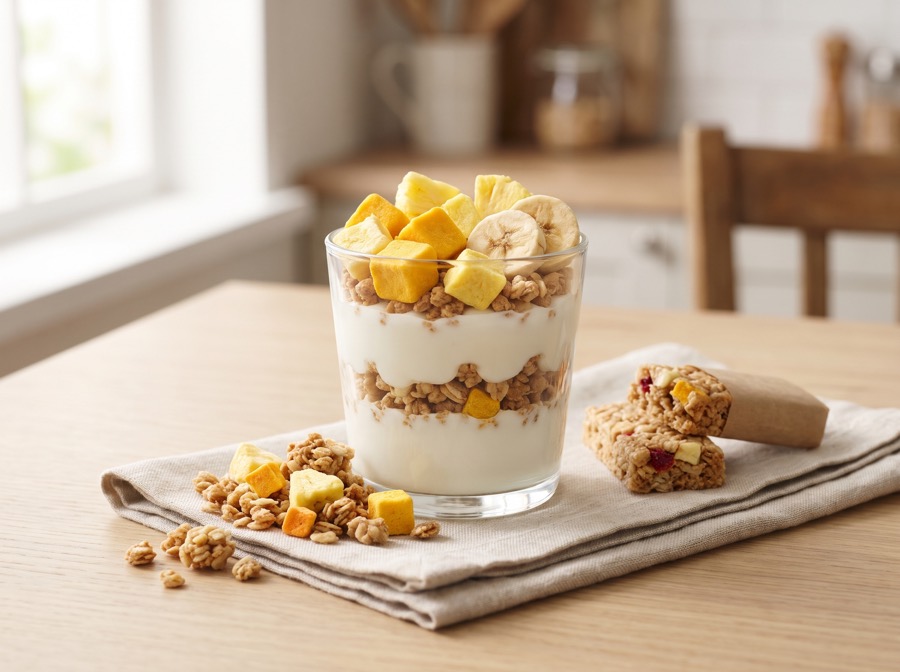
Freeze-dried fruit dice, vegetable pieces and herb flakes work as inclusions in cereal, granola, bars, chocolate and yogurt cups when their water activity matches the base. Add them after baking, in the coating or as a separate topper. Tomato, sweet corn and the herbs are certified organic.
01 — Piece size and cut
The inclusion has to fit the bite.
An inclusion is judged by eye and in the mouth. Too large, it dominates a spoonful or cracks a thin bar; too small, it disappears. Dice and small pieces usually suit cereal, granola and bars, while larger pieces suit a yogurt-cup topper or the face of a chocolate tablet.
From our range, the sweet inclusions are mango, pineapple and banana as pieces or dice. The savory inclusions are tomato and sweet corn pieces, diced onion and garlic, chili rings, oregano and basil flakes and thyme and rosemary leaves, all certified organic. When the standard piece is the wrong size, we develop a custom cut with you. For crunchy fruit eaten on its own, see fruit snacks.
Freeze drying keeps the color of the fresh crop better than hot air does, which is why a freeze-dried mango dice is still orange and a basil flake still green. In a mixed product, that color tells the consumer the fruit or herb is real.
02 — Moisture migration
Water moves until the water activities meet.
Most inclusion failures are moisture failures.
- Water activity
- How freely the water in a food is available, on a scale from 0 to 1. Freeze-dried fruit and vegetable powders are reported at about 0.20 to 0.35; microbes cannot grow below 0.60.
- Moisture migration
- Water moves from the component with the higher water activity to the one with the lower, not from the wetter to the drier by moisture content. In a granola with a moist cluster, the freeze-dried fruit takes up water and softens.
- Matching
- Formulating the base close to the water activity of the inclusion, so that little water moves. A dry, toasted cereal or a chocolate is already close; a soft bar or a yogurt is not.
- Barrier
- A fat-based layer, such as a chocolate or compound coating, around the piece. It slows water reaching a freeze-dried inclusion that sits in a moist base.
- Fines
- The small fragments that break off porous pieces in handling. A limit on fines belongs in the specification, because they color a white base and settle at the bottom of a pack.
03 — Base by base
Where the inclusion goes in, for each base.
The usual rule: add freeze-dried pieces dry, after the heat.
| Base | Inclusion from our range | When to add | Moisture note |
|---|---|---|---|
| Breakfast cereal | Fruit dice or small pieces | Dry-blended after toasting and coating | A dry cereal sits close to the fruit, so the pieces stay crisp in the box. |
| Granola | Fruit dice; sweet corn pieces for savory granola | After baking, once the clusters have cooled | Moist clusters or added dried fruit will soften the freeze-dried pieces. |
| Cold-formed bars | Fruit dice; tomato pieces or herb flakes for savory bars | Folded into the binder at the end of mixing | The binder's water activity decides how long the inclusion stays crisp. |
| Chocolate | Fruit pieces, dice or powder | Stirred into tempered chocolate or set on the back of the tablet | Chocolate is a fat matrix, a natural barrier around the piece. |
| Yogurt cups | Fruit pieces | In a separate topper compartment, mixed in by the consumer | In contact with yogurt the piece takes up water quickly; see rehydration and use. |
| Crackers and savory snacks | Rosemary and thyme leaves; oregano flakes; diced onion and garlic | In the dough or as a topping before baking | Here the herb is for flavor and fleck; crunch comes from the cracker. |
General practice, not tested results with our ingredients.
04 — Herbs as inclusions
Herbs belong in the savory inclusions.
Herbs add color and aroma at a low dose wherever a snack turns savory.
- Savory bars and bites: oregano or basil flakes with tomato pieces give a recognizable flavor and visible flecks.
- Crackers and crispbreads: rosemary and thyme leaves hold their shape in a dough and read as whole herb on the surface.
- Savory granola and seed clusters: diced onion and garlic, chili rings and sweet corn pieces.
- Freeze drying uses no hot air, so less of the volatile oil that carries an herb's aroma is driven off before it reaches your line.
- Herbs are dosed far lower than fruit; compare two or three cuts in the same base.
Questions
Questions buyers ask about freeze-dried inclusions.
Why do freeze-dried inclusions go soft in a bar or granola?
Water moves from the base into the inclusion until their water activities meet. A freeze-dried piece at very low water activity in a moister base takes up water and loses its crunch, so the base should be formulated close to the inclusion's water activity or the piece protected by a fat-based coating.
When should freeze-dried pieces be added to a baked product?
After baking and cooling, dry-blended or folded in at the end of mixing, so the pieces never go through a hot, wet stage. Herbs used for flavor in a cracker dough are the exception.
Which freeze-dried inclusions does FD Harvest supply?
Mango, pineapple and banana pieces or dice, and tomato and sweet corn pieces, diced onion and garlic, chili rings, herb flakes and herb leaves (certified organic). Custom cuts are developed on request.
Can freeze-dried fruit go into chocolate?
Yes. Chocolate is a fat-based matrix with very little available water, so freeze-dried fruit pieces, dice or powder stay crisp in it longer than in a water-based filling.
Can I get a smaller dice for a thin bar or cereal?
FD Harvest develops custom cuts with you, piloted small at the plant, with no minimum order. Free samples come with a spec sheet.
How are freeze-dried inclusions packed and stored?
They are packed straight after drying in metalized pouches, because they take up moisture from the air. Kept sealed, FD Harvest ingredients have a shelf life of 3 years; once opened, reseal and keep dry.
Contact us to discuss your product requirements.
Tell us the base, the piece size and where the inclusion goes in. We will send samples of the cuts that fit.
Contact usSources
- METER Group, Solving moisture issues in snack foods
- Moisture and water activity of freeze-dried powders, Sci. J. Gdynia Maritime Univ.
- Braun C., Freeze Drying Foods, SDSU Extension P-00357 (2025)
- Ratti C., Hot air and freeze-drying of high-value foods: a review, J. Food Eng. 49 (2001)
- Huopalahti R. et al., aroma of dried dill, Agric. Food Sci. 57 (1985)